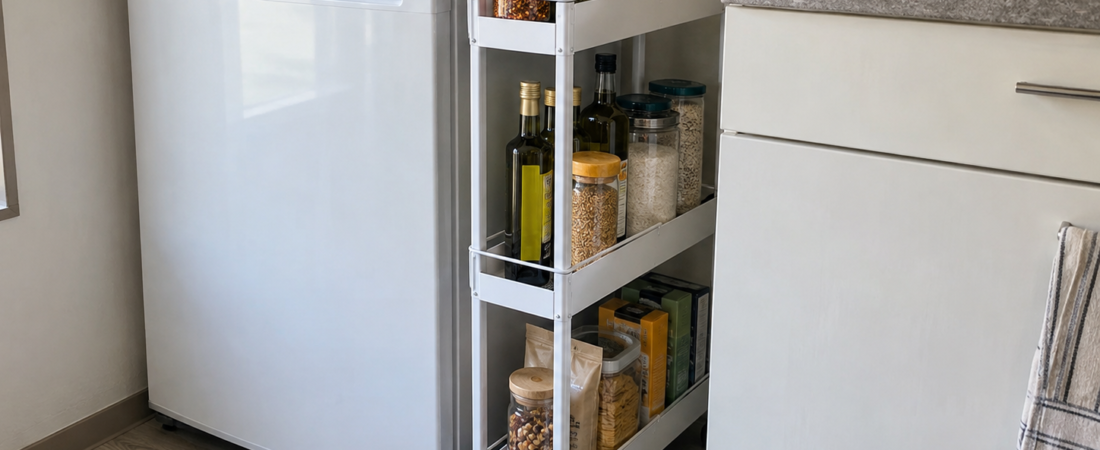
Small rental kitchen pantry storage can feel difficult when you have limited floor space and no built-in pantry. But with careful measurements and a few renter-friendly storage solutions, you can create a functional pantry without permanently changing the property. This guide will help you choose the right solution for your space, starting with safety.
1. Start With Safety and Movement
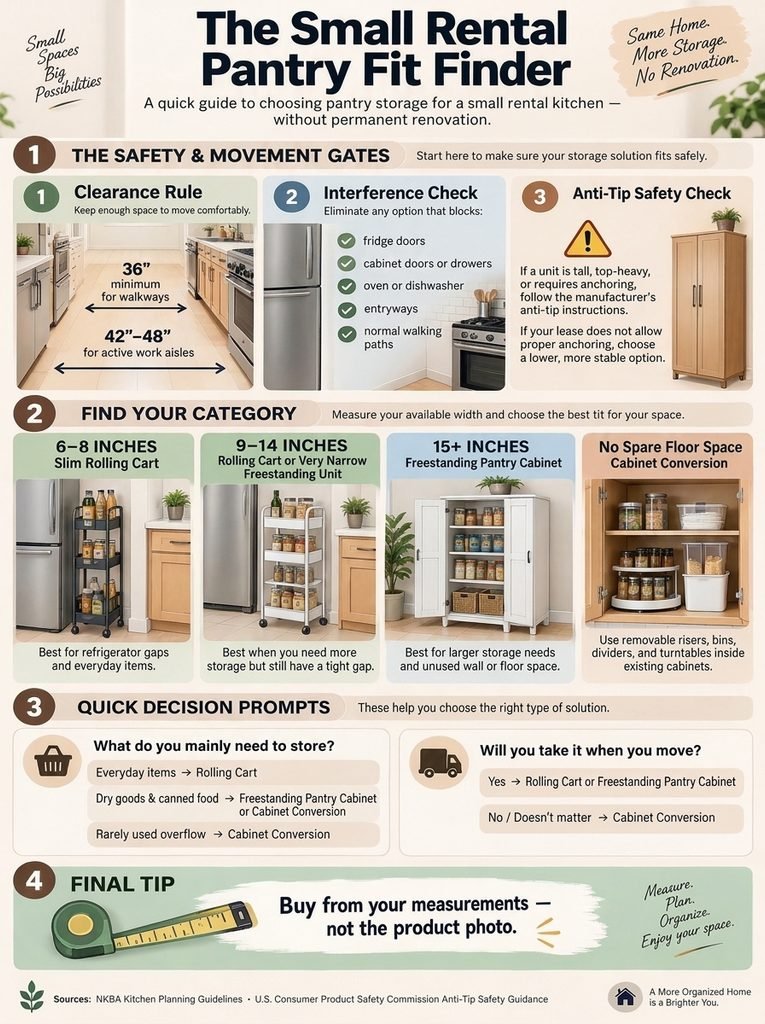
Before choosing any storage unit, establish your safety and movement limits. Kitchen planning guidelines from the NKBA recommend keeping walkways and work areas clear. As a general planning guideline, keep at least 36 inches of clearance for walkways and around 42 to 48 inches for active work aisles. Always measure carefully. Make sure your new pantry solution does not block refrigerator doors, cabinet doors or drawers, the oven or dishwasher, entryways, or normal walking paths.
If a rolling cart prevents your refrigerator door from opening properly, that option should be eliminated. If a storage unit is tall, top-heavy, or comes with manufacturer instructions requiring wall anchoring, follow those instructions. Before drilling or installing permanent hardware in a rental, check your lease. This can help you avoid unnecessary damage and possible deductions from your security deposit when you move out.
Measure the Space You Actually Have
Measure the available width, depth, and height of the space where you want to add storage. Then imagine the storage unit in place and check whether refrigerator doors, drawers, cabinet doors, appliances, and walking paths can still open and function normally.
When comparing products, use the full exterior dimensions rather than relying on labels such as “slim” or “narrow.” Wheels, handles, frames, and rails can add extra width or depth that may determine whether the item actually fits.
2. Small Rental Kitchen Pantry Storage: Find What Fits
Once you know your safety clearances, measure the exact width of the space where you want to add storage. Then use that measurement to narrow down your options. Think of these width ranges as practical starting points for choosing a storage category.
Check the Widest Point Before You Buy
Before choosing a product, check the widest point of the unit, including wheels, handles, frames, rails, or any parts that extend beyond the main body. A cart that looks slim in a product photo may still be too wide for the gap you measured.
Also check the manufacturer’s weight limit before using a rolling cart for heavy canned goods, glass containers, or liquids. When possible, keep heavier items on the lower shelves to improve stability.
6–8 Inches — Slim Rolling Cart
If you have a narrow refrigerator gap or another small unused space, a slim rolling cart can provide practical storage for everyday items.
9–14 Inches — Rolling Cart or Very Narrow Freestanding Unit
With a little more room, you may be able to use a wider rolling cart or a very narrow freestanding unit. This can work well in awkward kitchen gaps that would otherwise go unused.
15+ Inches — Freestanding Pantry Cabinet
If you have at least 15 inches of available width and enough safe floor space, a freestanding pantry cabinet may give you significantly more storage. Always check the cabinet’s dimensions, door clearance, walking space, and anti-tip instructions before buying.
Before choosing a freestanding pantry cabinet, measure more than just the available width. Check the floor depth, total height, ceiling clearance, nearby fixtures, cabinet doors, drawers, and the walking space that will remain once the unit is in place.
If the manufacturer requires an anti-tip restraint, follow those instructions. If your rental does not allow the unit to be anchored properly, choose a lower, more stable storage option instead.
No Spare Floor Space — Cabinet Conversion
If your kitchen has no room for another piece of furniture, focus on the cabinets you already have. Renter-friendly organizers such as cabinet shelf risers, Lazy Susans, clear bins, vertical dividers, and removable pull-out organizers can help you use the available space more efficiently.
Measure the inside of the cabinet before buying organizers. Check the interior width, depth, and height, and account for hinges, plumbing, shelf supports, and door frames that can reduce the usable space.
Shop by actual dimensions instead of labels such as “small” or “large.” Removable shelf risers, clear bins, Lazy Susans, vertical dividers, and pull-out organizers can help you use vertical and deep cabinet space without permanently modifying the rental.
3. Ask These Quick Questions Before Choosing
What do you mainly need to store? Everyday items may work best on a rolling cart, while dry goods and canned food may fit better in a freestanding cabinet or organized cabinets.
Also consider portability. A rolling cart or freestanding cabinet can move with you to your next apartment. Internal cabinet organizers are easy to remove but are designed to improve the cabinets you already have.
4. Final Tip
The best pantry solution is not the one that looks good in a product photo. It is the one that fits your real measurements and works with your daily routine.
A slim rolling cart can be one inch too wide. A freestanding cabinet can reduce your walking space. A pull-out organizer can hit a hinge. And a tall cabinet may require anti-tip anchoring.
Before buying, measure your space, check how the kitchen moves, read the product dimensions and safety instructions, and then make your choice.
The goal is not a Pinterest-perfect pantry. It is storage that actually works in your rental and can make everyday life easier.
Sources & References
National Kitchen & Bath Association (NKBA) — Kitchen Planning Guidelines
U.S. Consumer Product Safety Commission (CPSC) — Anti-Tip Safety Guidance